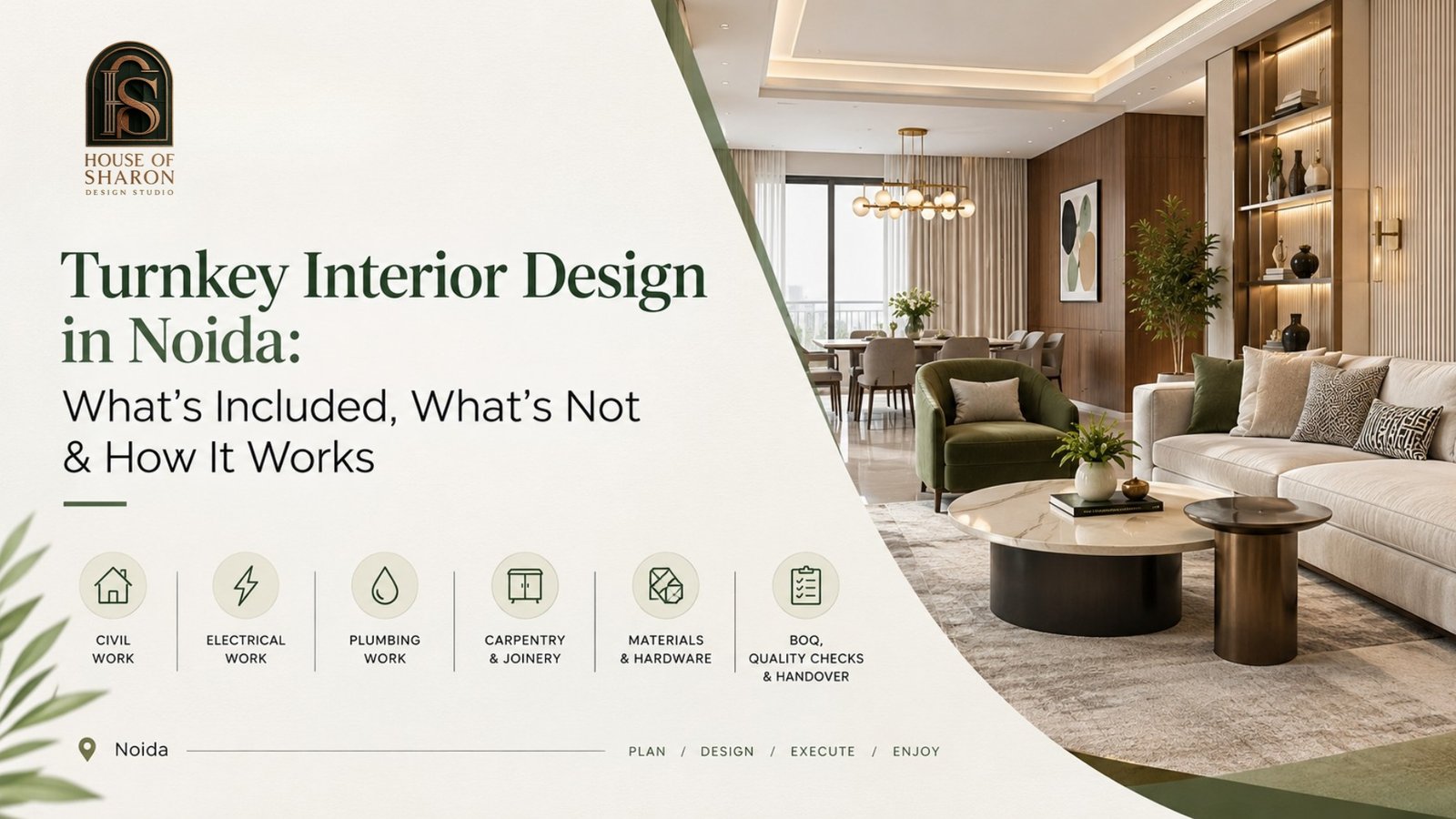
If you are planning a complete home interior in Noida, you will probably come across the term “turnkey interior design.” But what does turnkey actually mean?
In simple terms, a turnkey interior project combines design, planning, procurement and execution under one coordinated scope. Instead of the homeowner separately managing a civil contractor, electrician, plumber, carpenter, painter and other vendors, the interior design studio coordinates the agreed works through the project.
However, “turnkey” does not automatically mean everything is included. The exact scope depends on the project's BOQ, specifications, agreement and exclusions.
That distinction is important before comparing quotations from interior design studios in Noida.
What is included in turnkey interior design?
The scope varies from project to project, but a residential turnkey interior project can include several of the following:
Civil work
Depending on the approved design, civil work may include wall breaking or removal where permitted, masonry, tile work, plastering and other modifications required for the interior.
Not every project needs all of these works, so they should be specifically listed in the BOQ rather than assumed.
Electrical and plumbing work
Electrical work can include wiring, shifting or adding points, lighting provisions, switches and other requirements shown in the electrical drawings.
Plumbing work may be required for kitchens, bathrooms, utility areas or other locations where fixtures or layouts are being modified.
These services need to be coordinated with furniture and ceiling layouts so that points are completed before the relevant finishing work.
False ceiling and lighting
False ceiling work can form part of a turnkey scope where the design requires it. It may accommodate lighting, electrical provisions and other ceiling elements.
The type of ceiling material, profile, lighting fixtures and installation requirements should be specified before execution.
Carpentry and wooden work
Carpentry can include wardrobes, kitchen cabinets, TV units, storage, wall panelling and other customised furniture.
The material specification matters as much as the design. The BOQ should identify the board or plywood specification, thickness, finish and hardware wherever applicable.
BWR vs. BWP plywood: does it matter?
Yes, particularly in areas exposed to moisture.
BWR means Boiling Water Resistant, while BWP means Boiling Water Proof. These are different specifications and should not be treated as interchangeable. BWR is generally used where moisture resistance is required, while BWP is suited to applications requiring greater resistance to water exposure.
For example, a designer may specify different grades for wardrobes, kitchen cabinetry and areas around a sink depending on the location, exposure and project specification.
The important question is not simply “Which plywood brand are you using?” Ask:
-
What plywood grade is specified?
-
What thickness is being used?
-
Where is each grade being used?
-
What standard does the specified product conform to?
-
Is the specification written into the BOQ?
That level of detail makes a turnkey quotation much easier to compare.
What about hardware?
Hardware can significantly affect both functionality and cost.
Depending on the project and specification, options can include brands such as Hettich, Häfele, Ozone and Dorset, among others. Different ranges within the same brand can also vary in mechanism, finish, load capacity and price.
Therefore, simply writing “premium hardware” in a quotation does not provide enough information.
A better BOQ identifies the relevant brand, product/range and specification wherever practical.
What is NOT automatically included in turnkey interiors?
This is one of the most important things to understand.
A project being called “turnkey” does not automatically mean every possible service or product is included.
Depending on the contract, exclusions may include:
-
Appliances
-
Loose furniture
-
Curtains and soft furnishings
-
Decorative accessories
-
Certain civil or structural modifications
-
Society or building permissions
-
Work outside the agreed BOQ
-
Upgrades requested after design approval
-
Certain external or specialist services
The exact exclusions should be discussed before signing.
Never compare turnkey quotations on the final price alone. Compare the scope behind that price.
How does a turnkey interior project work?
A well-organised turnkey project generally follows a sequence like this:
1. Requirement discussion
The designer understands the home's layout, lifestyle requirements, storage needs, aesthetic preferences and project scope.
2. Space planning and design
Layouts, furniture planning, materials, finishes and other design elements are developed and approved.
3. Detailed drawings and BOQ
The approved design is translated into drawings, quantities, specifications and a BOQ.
4. Material finalisation
Materials, finishes, hardware, fixtures and other products are selected according to the approved specifications.
5. Site execution
The agreed civil, electrical, plumbing, ceiling, carpentry, painting and other works are coordinated.
6. Quality checks
Work is checked at different stages rather than waiting until the end. This is important because correcting an issue after subsequent work has covered it can be more difficult.
7. Snagging and handover
The completed work is inspected, pending issues are recorded and addressed as applicable before handover.
This design-to-execution workflow is one of the main practical differences between simply receiving an interior design concept and engaging a studio for end-to-end execution.
Why is the BOQ so important?
The Bill of Quantities (BOQ) is one of the most useful documents for a turnkey interior project because it helps define what is being supplied and executed.
A detailed BOQ can identify:
-
Quantity
-
Material
-
Brand
-
Grade/specification
-
Size or thickness
-
Finish
-
Hardware
-
Unit rate
-
Total cost
-
Inclusions and exclusions
Without sufficient specification, two quotations may appear similar while actually covering very different materials and scopes.
Is turnkey interior design more convenient?
For homeowners who do not want to coordinate multiple contractors themselves, turnkey execution can provide a single project structure for design and execution.
But convenience should not come at the expense of transparency.
Before appointing an interior design studio in Noida, ask for clarity on the scope, BOQ, materials, hardware, payment milestones, timeline, quality checks, exclusions and handover process.
The objective is not simply to find the lowest quotation. It is to understand exactly what you are receiving for the amount quoted.
Turnkey Interior Design in Noida with House of Sharon
At House of Sharon Design Studio, turnkey interior design is approached as a coordinated process from design development through execution.
For homeowners in Noida, the focus should be on making the scope clear before work begins from space planning and material specifications to site execution and finishing.
If you are considering a turnkey interior project, discuss your requirements, property layout, scope of work and expected level of finish before finalising the project.
Book a Consultation or Chat with us on WhatsApp
Frequently Asked Questions
What does turnkey interior design mean?
Turnkey interior design is an end-to-end service in which the agreed design and execution works are coordinated through one interior design studio or project team. The exact scope depends on the project BOQ and agreement.
What is included in turnkey interior design in Noida?
Depending on the project, it can include civil work, electrical work, plumbing, false ceiling, carpentry, wall panelling, painting, material procurement and installation. The exact inclusions should be confirmed in writing.
Does turnkey interior design include furniture and appliances?
Not necessarily. Appliances, loose furniture, curtains, décor and other items may be excluded unless specifically included in the BOQ or agreement.
Is plywood included in a turnkey interior project?
Plywood or other board materials can be included when they form part of the agreed furniture or cabinetry scope. The BOQ should specify the material grade, thickness and application.
What is the difference between BWR and BWP plywood?
BWR is Boiling Water Resistant, while BWP is Boiling Water Proof. They have different moisture-resistance properties, so the appropriate specification should be selected according to the application and exposure.
Does turnkey interior design include electrical and plumbing work?
It can, but this should not be assumed. Electrical and plumbing work should be specifically listed in the project's scope and BOQ, including the extent of work and relevant specifications.
How do I compare turnkey interior quotations?
Compare the detailed scope rather than only the total price. Check the BOQ, material grades, brands, hardware, quantities, finishes, exclusions, payment schedule, timeline and handover terms.
Why is quality control important in turnkey interiors?
Several interior works are interdependent. An issue with electrical, plumbing, carpentry, materials or finishing can become harder to correct after subsequent work is completed. Stage-wise checks help identify problems earlier.
How long does a turnkey interior project take?
There is no single timeline for every project. Duration depends on the size of the property, design complexity, scope of civil work, material availability, custom furniture, approvals and execution requirements. A project-specific schedule should be agreed before work begins.
How much does turnkey interior design cost in Noida?
There is no reliable single price because turnkey costs depend on the property's size, scope, materials, finishes, hardware, custom furniture, civil work and project requirements. A detailed BOQ is more useful than a generic per-square-foot figure when comparing quotations.
« Back to All Blogs
